The most common question buyers ask me when planning a heated wrap line is about heat settings or fabrics. The question they should ask first is about power. Whether your wrap plugs in or runs on a battery quietly decides the price, the weight, the customer’s daily routine, and even the review score your product earns later on. The USB vs rechargeable heated wraps decision is the one choice that touches every other spec on the sheet, so it’s worth slowing down on.
Why the Power Option Decides Your Customer Experience
Think about what power actually controls. A battery-built wrap can go anywhere the customer goes, but it needs charging and adds weight to the garment. A plug-in wrap delivers steady heat for as long as it’s on, but it anchors the customer to a wall outlet or a power bank. Neither is better in the abstract. One of them is better for your buyer, and figuring out which one is the real job here.
Power also shapes your business side. Batteries add cost per unit, add shipping considerations, and add a support dimension: customers will eventually ask about charging behavior and battery care. Plug-in builds are cheaper to make and simpler to support, but they cap how the product gets used. When buyers come to us as their heated wrap OEM manufacturer, this is the first fork in the road we ask them to commit to, because everything downstream depends on it.
USB (Plug-In and Power Bank) Builds
A USB-powered wrap draws its heat from a wall adapter, a laptop port, or a compatible power bank. The experience is predictable: plug in, heat comes on, and it stays at the level you set for as long as you want it. There’s no battery fading halfway through a session, which some customers genuinely prefer.
The strengths are practical. Lower unit cost, because you’re not paying for cells. Lighter garment. Simpler compliance conversation. And for a specific kind of customer, the routine is a feature rather than a limitation: someone at a desk all day, or an older buyer who likes the same plug-it-in ritual every evening. Wraps in this style suit office use, couch time, and anyone who keeps one spot as their recovery corner.
The trade-off is the cord. Tethered use means the wrap lives where the outlet lives, and “just walk around with it” isn’t in the product’s vocabulary. If your marketing shows someone wearing the wrap while doing chores or commuting, a plug-in build will disappoint them.
Two spec questions matter more than buyers expect here. First, which power banks actually work with the wrap: output requirements vary between banks, so get the factory to state what’s compatible and print it in the manual before customers find out by trial and error. Second, whether an adapter ships in the box. Including one raises your cost slightly but removes the single most common complaint in this category, which is a customer with a working wrap and nothing to plug it into.
Rechargeable Builds
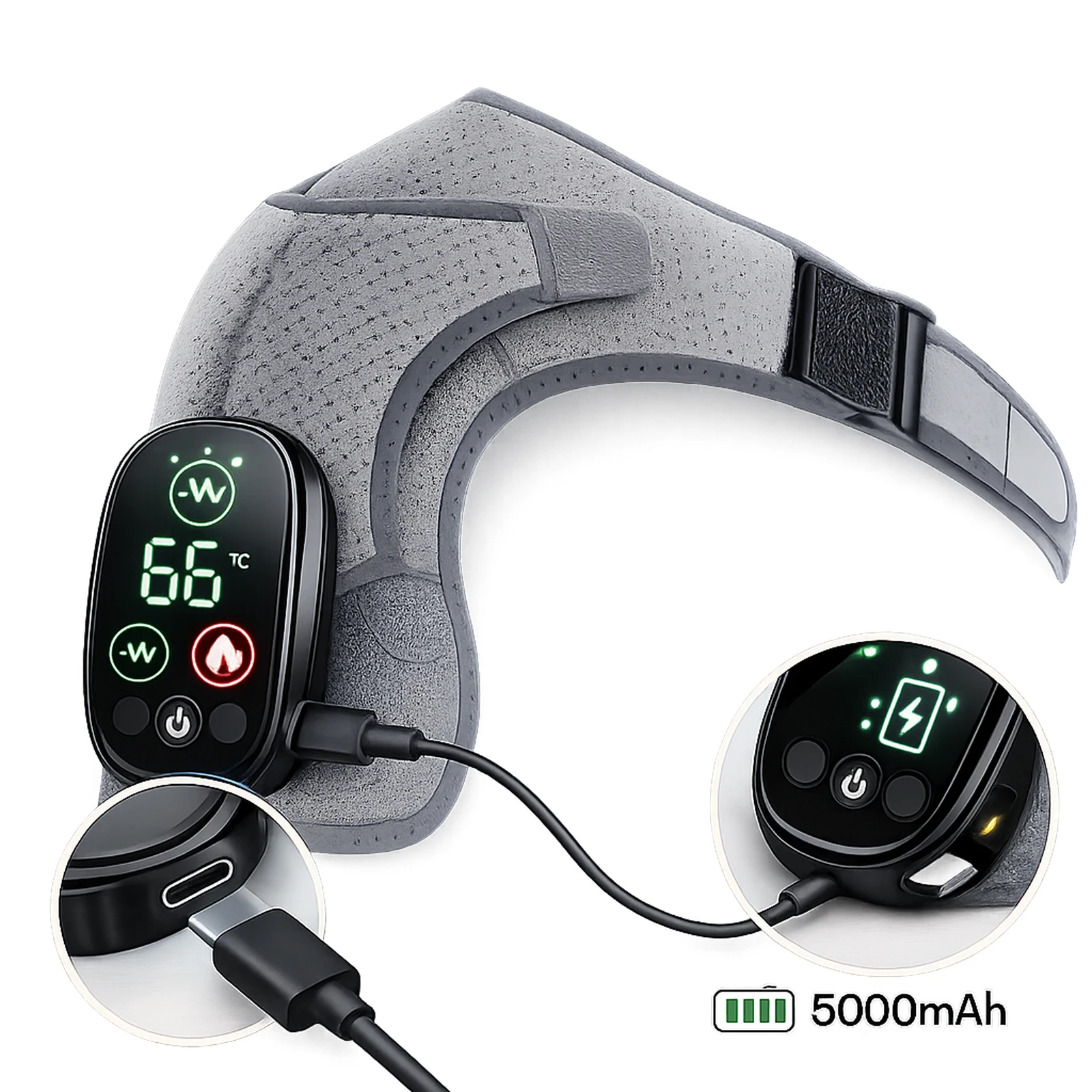
Rechargeable wraps carry their own battery, usually in a pocket or an integrated control unit, and charge over Type-C like everything else in your customer’s life. This is the build people picture when they imagine the category: heat at the knee while gardening, heat at the shoulder while cooking dinner, no cable pulling at the strap.
Our rechargeable heated shoulder wrap is a good example of what buyers should expect from this class of product: fully cordless, three heat settings, three vibration modes, and Type-C charging that works with the cables customers already own. When you brief a factory on a rechargeable build, the questions to ask are runtime at each heat level, charge time, and where the battery sits on the body. Weight distribution matters more than most first-time buyers expect; a pocket that sits right on the shoulder joint gets noticed within minutes.
The honest trade-off is that you’re now selling a device that needs charging. Some customers will forget, and a few reviews will mention it. Clear manual copy and a sensible low-battery indicator on the controller handle most of that before it happens.
There’s also a packaging angle that works in your favor. Rechargeable builds present beautifully as kits: wrap, controller, charging cable, and a storage pouch in one gift box. That presentation supports a higher retail price, which is part of why the rechargeable tier usually carries your better margin even after the extra unit cost. Just make sure your supplier quotes the kit contents line by line, because “kit included” can mean very different things between two factories.
Matching the Option to Your Market
Here’s the simplified version I give buyers when they’re stuck between the two.
- Retail and gift channels: rechargeable, most of the time. A cordless demo is easier to sell in-store, and the unboxing moment lands better when the product isn’t attached to a cable. Gift buyers also expect the “charge it like my phone” simplicity.
- Gyms and studios: consider both. Plug-in units work well in a fixed recovery corner where members sit still anyway, while rechargeable units suit facilities that hand wraps out for warm-ups or cool-downs around the floor.
- Amazon resellers: search demand leans rechargeable, but plug-in builds can win on price in a crowded listing. Read your niche before committing; we covered the cordless-versus-corded tension in our earlier cordless vs plug-in comparison using shoulder wraps as the example.
One last option worth naming: you don’t have to pick just one. Plenty of the brands we work with run both builds in parallel, using a plug-in version as their entry price point and a rechargeable version as the premium tier. It doubles your listing coverage without doubling your design work, since the two versions can share the same fabric, straps, and controller layout.
Whichever way you lean, lock the decision into your brief before anything else gets designed. If you’re still mapping the full line, the heated wrap OEM/ODM guide covers how the power choice interacts with MOQ, packaging, and your first sample round.
Ready to build your heated wrap line?
Tell us your target market and form factor — we’ll send a brief template and a sample quote.