If you’ve been circling the wellness space for a while, trying to pick a first product without betting the whole company on it, let me make the case for heated wraps. Of everything we manufacture, they are the easiest line for a new brand to launch. The heating technology inside is mature, customers understand the product in one sentence, and the certification path is lighter than it is for light-therapy devices, because there is no photobiological testing to plan for, only the standard electrical safety work any powered product needs. Demand is broad, too: knee, shoulder, and waist wraps cover gym members, desk workers, and people shopping for their parents all at once. That mix of simplicity and reach is why so many first-time founders come to us for heated wrap OEM/ODM.
Easy to launch does not mean decision-free. You still need to choose a form factor, a power option, a controller, and a packaging story, and you need a factory that can deliver all four without surprises. This guide walks through what an OEM relationship actually involves, what our current heated wrap platform looks like, and what belongs in your first spec sheet. If you want to see the same logic applied to our light-therapy side, the red light therapy OEM/ODM guide covers that in the same depth.
What a Heated Wrap OEM Manufacturer Actually Does
Strip away the trade-show jargon and an OEM partnership comes down to four jobs.
- Design adaptation. You bring a reference product, a sketch, or just a description of your market. We adapt the design to fit: sizing ranges, strap length, fabric choice, where the controller sits. A wrap aimed at older buyers needs a bigger buckle and simpler buttons than one aimed at gym-goers, and those details get decided here, not on the production line.
- Heating element and controller integration. This is the part customers never see but always feel. The heating element, the temperature control logic, and the hand controller have to work as one system. Get it wrong and you get wraps that run warm at the center but cool at the edges, or controllers that confuse people. Get it right and nobody notices, which is exactly the point.
- Branding and packaging. Your logo on the product, your colors on the gift box, your manual in your customers’ language. For retail, the box is the first thing a shopper sees, so we treat packaging as part of the product rather than an afterthought.
- Certification support. We prepare the technical documentation and test reports your target market expects for an electrical wellness product, and we point you toward the right labs when a market requires something extra. The questions buyers ask most at this stage are collected on our FAQ page.
One thing I always tell new buyers: a good factory will push back on you somewhere in this process. If a supplier agrees with every request instantly and never asks a question, that usually means nobody actually read your brief.
Our Current Heated Wrap Platform
We build heated wraps for the three joints where demand is steadiest, and each model below ships today with your branding from the first sample onward.
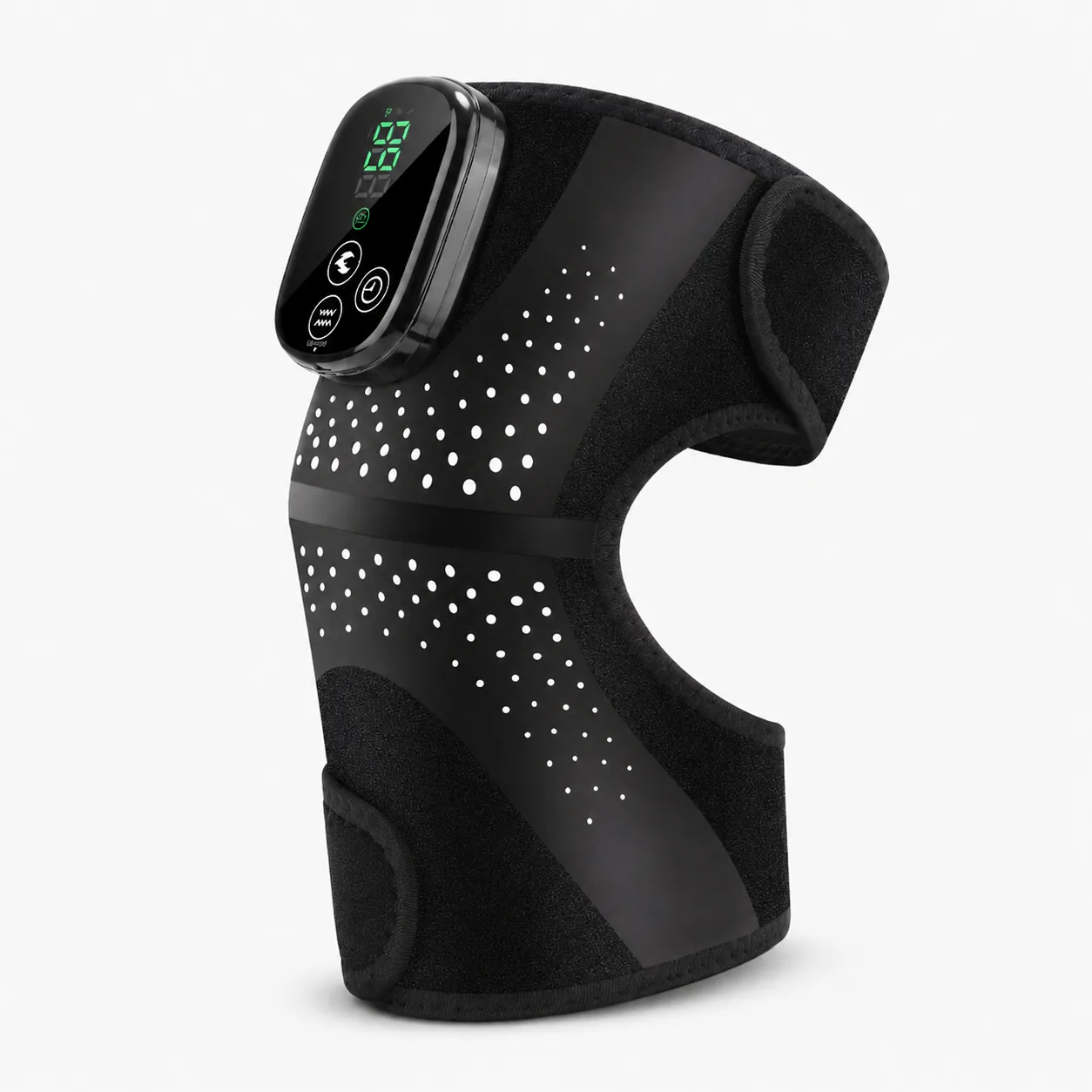
- Knee: the KM001 rechargeable heated knee wrap pairs heat with vibration massage, charges over Type-C, and ships as a complete kit, which makes it an easy SKU to gift-box and a natural first order.
- Shoulder: the SM001 rechargeable heated shoulder wrap is fully cordless, with three heat settings and three vibration modes, built for people who want to keep moving while they wear it.
- Waist: the WM001 air compression heated waist massager is the most feature-rich of the three: four-zone air compression, adjustable heat, four vibration modes, and a rechargeable integrated control unit.
The full range, including a few models we haven’t mentioned here, lives on our heated massage products category page. If you already know which joint you want to target, our supplier pages for the knee, the shoulder, and the waist each go deeper on sourcing that specific form factor.
OEM vs ODM for Heated Wraps
These two words get used loosely across the industry, so here is how we draw the line.
OEM means you take an existing platform, like the three models above, and we modify it for your brand: logo, fabric colors, packaging, manual, sometimes a small hardware tweak. The heating system itself stays proven, so timelines are short and tooling costs stay close to zero. For a first order, this is almost always the right call, and evaluating a heated wrap OEM manufacturer at this stage is really about reliability: sample quality, communication speed, and how honestly they handle the problems that will come up.
ODM goes further. You want heating zones arranged differently, a controller with your own button logic or firmware behavior, or a form factor nobody currently sells. That means new engineering, new tooling, and a longer runway before launch. It also means real differentiation on the shelf, which is why second-time buyers tend to come back with an ODM brief instead of another OEM request.
A pattern I see often: a brand launches with an OEM version of one wrap, spends a season learning what customers actually ask for, then funds an ODM version from the profits. The first order proves the channel. The second order builds something competitors can’t copy with a screenshot.
Spec Sheet Checklist for Buyers
Whether you brief us or another factory, put these six lines in writing. Ambiguity in a spec sheet is where budgets quietly die.
- Heating element type. Different elements distribute warmth differently across a wrap. Ask what is inside, where the warmest zones sit, and check the sample against the answer.
- Heat settings. How many levels, and what is each level for? Two or three well-spaced settings beat five settings nobody can tell apart.
- Power option. Rechargeable battery, plug-in, or both? This single choice shapes price, weight, and daily usage. We break down the full trade-off in the first guide of this series.
- Controller. Built-in buttons or a separate unit? Heat only, or heat plus vibration? Simpler controllers generate fewer support tickets, which matters once you scale.
- Fabric and straps. Neoprene holds warmth well; breathable fabrics suit longer sessions. Confirm strap adjustability across your whole size range, not just the medium.
- Packaging and manual. Gift box or plain mailer? Which languages? An insert card with your brand story? Decide before production starts, not after the goods land.
One more line worth adding to every brief: a reminder that this is a wellness product. Marketing language about comfort, relaxation, and soothing tired muscles keeps you on the safe side of the line. Treatment or cure claims pull you into medical-device territory, and that is not a road you want your first product on. If you’re still weighing heat against light therapy as a category, we compared a red light wrap vs heated wrap in an earlier post.
From Sample to Bulk Order
Now the numbers, because this is where most first-timers get nervous.
Our MOQ is 300 pieces per SKU. I know that sounds like a lot when you’re testing a market, but custom packaging and a production run both carry fixed setup costs, and below a certain volume the per-unit price stops making sense for either of us. If 300 is genuinely out of reach, say so; sometimes an existing mold or shared components gets you a lower entry point on a first order.
After that, the timeline usually looks like this:
- Sample: 7 to 10 days. A working unit with your requirements applied, plus documentation, so you can evaluate the real thing before committing money.
- Mass production: 30 to 45 days from your approval of the pre-production sample. That window covers assembly, QC, and packing.
- Shipping: separate from production. Express for samples, sea or air freight for bulk, depending on how hard your launch date is.
Do not skip the sample round. I’ve watched buyers save themselves from a five-figure mistake because the sample’s strap sat awkwardly on one shoulder, or the controller felt flimsy in the hand. Ten days of patience is cheap insurance, and it’s the single best predictor of a smooth first bulk order. When you’re ready to start, send us your target market and form factor and we’ll take it from there.
Heated wraps will never be the flashiest product on your roadmap, but they are the most likely to earn you a second order. Start with one joint, one power option, and one honest sample round, and the rest of the line tends to build itself from there.
Related Guides in This Series
Ready to build your heated wrap line?
Tell us your target market and form factor — we’ll send a brief template and a sample quote.