Red Light Therapy Device Wavelengths Explained for Importers
Red light therapy device wavelengths are one of those questions importers get asked on a distributor call, and answering vaguely costs you credibility fast. You’re not chasing a novel product idea. You have channels, a customs broker, and buyers who will probe the spec sheet. So this is the short version I’d give you over coffee, without the marketing gloss.
Enough to hold your own with a distributor, and enough to catch a factory that’s rounding the truth.
Red Light Therapy Device Wavelengths and Body Penetration
Light is absorbed by whatever it hits. Shorter red wavelengths get absorbed sooner, so most of their energy lands at the surface. Longer near-infrared wavelengths pass through more of that surface layer before they’re absorbed, so more of the energy ends up deeper. That’s the whole idea. Everything else is refinement.
In practice you’ll see four numbers on spec sheets:
- 630nm — visible red, surface-focused. Common in facial and skin-oriented products.
- 660nm — visible red, slightly deeper, and the most widely stocked red chip in the industry. Bright, familiar, cheap at volume.
- 810nm — near-infrared. Available, but usually a special order rather than a shelf item.
- 850nm — near-infrared, the volume standard. Reaches into muscle tissue, and nearly invisible to the eye.
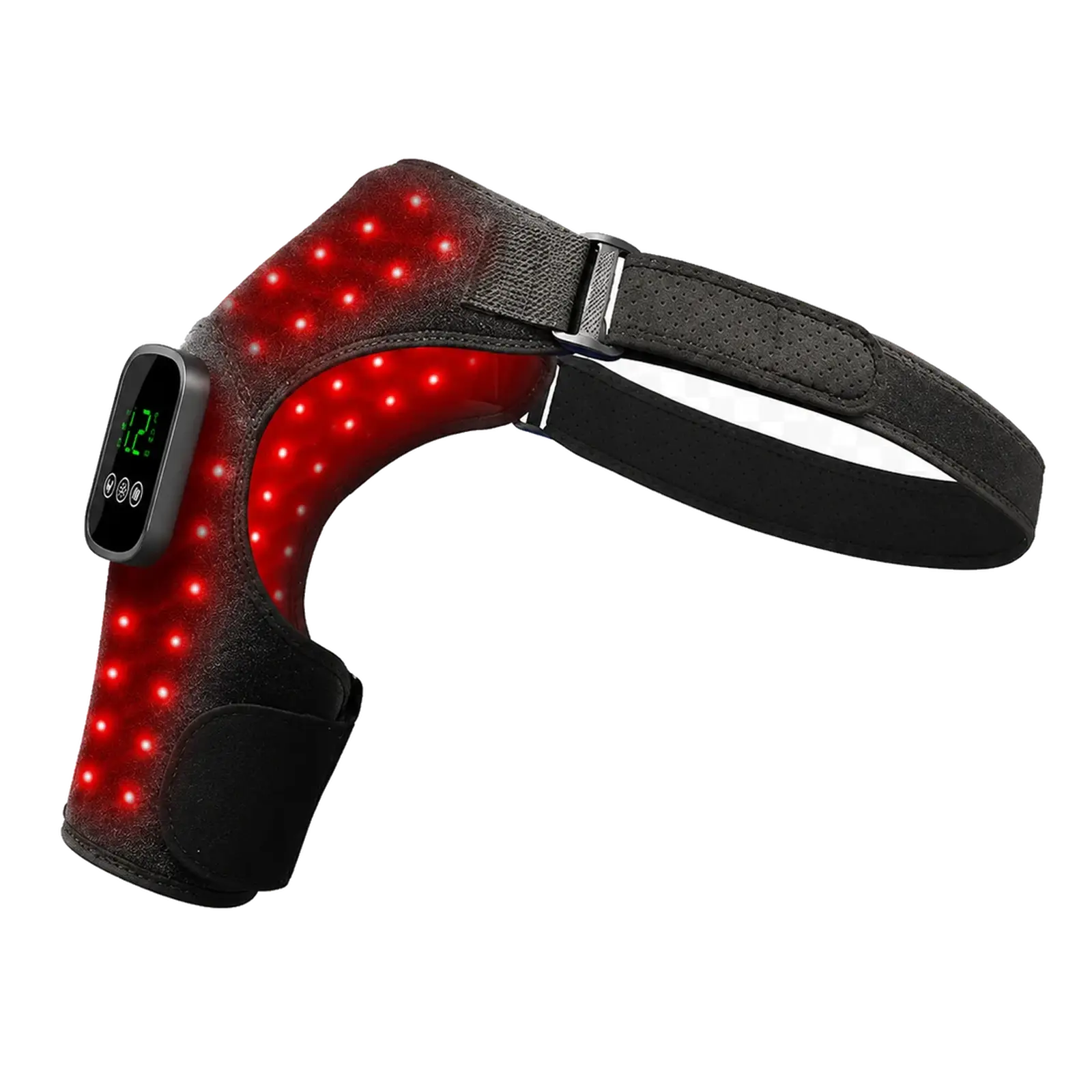
This is why combination chips matter so much commercially. A single package holding both a red and a near-infrared die lets a factory put surface and deeper coverage on the same board without doubling the LED count or the wiring. For a wearable, that means a thinner pad, a lighter unit, and better battery life on the same 5000mAh Type-C cell. For you, it means one SKU that answers both halves of the customer’s question.
The alternative is separate arrays: a bank of red chips and a bank of near-infrared chips, sometimes on independent circuits so the user can switch modes. That’s a legitimate build too, and clinics often prefer it. It’s just bigger, heavier, and more expensive to assemble.
One detail worth flagging to your sales team before launch: near-infrared light is essentially invisible. If a mode looks dark, customers assume a defect. Pairing NIR with visible red on the same board, or adding a small indicator, prevents a whole category of avoidable returns and one-star reviews.
Marketing Claims vs Compliance
Here’s where importers get into more trouble than manufacturers do, because you’re often the one writing the listing copy.
Red light devices in this category are wellness products. That’s the lane, and staying in it keeps your paperwork manageable. The moment your listing says a device treats arthritis, heals an injury, or cures pain, you’ve described a medical device, and in the US that means a completely different regulatory path involving a 510(k). Registering with the FDA is not the same as FDA clearance, and confusing the two in your copy is a genuine risk.
What you can say comfortably is the honest stuff anyway: warmth, comfort, muscle soothing, relaxation after training, easing general soreness, supporting recovery routines. Keep claims about wellness and you’ll find the language is still perfectly persuasive.
Two habits that save importers headaches:
- Give your distributors approved copy. If you don’t, they’ll write their own, and someone will eventually promise a cure on a marketplace you don’t control.
- Keep your certificates matched to your market. CE and ROHS for Europe, FCC for the US, UKCA for Britain, PSE or KC for parts of Asia. Photobiological safety testing under IEC 62471 is also worth holding for a light-emitting product, since serious retail buyers ask for it.
None of that is exciting. It’s the difference between a product on the shelf and a pallet sitting in a customs hold.
Spec Questions to Ask Your Factory
These are the questions that separate a supplier who builds their own boards from one who resells someone else’s. Ask them on the first call.
- Can you mix wavelengths on the same wrap? The answer should be an immediate yes with an example split, like 660 + 850 on one pad.
- Dual-chip package or separate arrays? Both are fine, but the honest answer tells you a lot. Dual-chip is lighter and cheaper; separate arrays give independent modes. A supplier who doesn’t know which they’re using is quoting someone else’s product.
- What’s the LED count per wavelength? Not the total. A total of 120 could be 60/60 or 100/20, and those are different products.
- What irradiance, measured how? mW/cm² means nothing without the distance and the meter. Numbers taken at skin contact and at 15cm are not comparable.
- What are the timer presets and auto-off? 10 / 15 / 20 minutes is the usual consumer set.
- Can I see it before I commit? Sample in roughly 7–10 days, production 30–45 days after you approve the pre-production unit, MOQ 300 per SKU. If a supplier resists sampling, that’s your answer.
Ask the same six questions to three suppliers and the differences show up immediately. Some will send a filled sheet the next morning. Some will send a catalogue and hope you stop asking.
If you want a concrete reference point, our red light knee wrap lists its wavelength split, coverage, and battery spec openly, and it’s a reasonable benchmark to hold other quotes against. The broader process — briefing, tooling, packaging, and localisation — is laid out in our guide to working with a red light therapy OEM manufacturer.
Understanding the spec sheet won’t make you a photonics engineer, and it doesn’t need to. It needs to make you the importer who asks the second question after the first one gets a smooth answer. That’s usually enough.
If you are weighing which wavelengths your first product should actually use — 630, 660, 850 and where each fits — see our companion piece on choosing between 630, 660 and 850nm.
Ready to take the next step on your red light product?
Tell us your target market and form factor — we’ll send a brief template and a sample quote.