Red Light Therapy Wavelengths 630 660 850: Which Mix Should Your Device Use?
Red light therapy wavelengths 630 660 850 come up in nearly every first email from a new buyer. It usually arrives as a version of the same question: which one should my device use? The honest answer is that none of them wins on its own, because they do different jobs. What matters is the mix, and the mix depends on what you’re building and who you’re selling to.
I’ve watched buyers spend two weeks debating a 30nm difference and then forget to specify the strap material. The numbers matter, but they get settled on the spec sheet rather than in the argument. So let’s do that part quickly and get you back to the decisions that actually move your margin.
Red Light Therapy Wavelengths 630 660 850 in Practice
Everything in this category splits into two families, and once you see the split the numbers stop feeling arbitrary.
630 and 660 are visible red. You can see them. They give that deep red glow customers associate with the whole category, and they stay closer to the surface — skin and the tissue just underneath. Of the two, 660 is the workhorse. It’s the most widely stocked red chip in wraps and panels, it looks brighter to the eye, and it sits slightly deeper than 630. 630 shows up more in facial and skincare-adjacent products where surface coverage is the whole point.
810 and 850 are near-infrared. Your eye barely registers them, maybe a dull violet shimmer at the edge of the array. They reach further into muscle, which is why recovery-focused products lean on them. 850 is by far the easier of the two to source at volume, so it’s cheaper per chip and shorter on lead time. 810 exists and we can build it, but it’s a special order rather than something sitting in the warehouse.
Here’s a practical wrinkle nobody mentions until it bites you: because near-infrared is nearly invisible, some customers assume the unit is broken. Most factories, us included, either pair NIR chips with visible red on the same board or add a small indicator so there’s something to look at. Sounds cosmetic. It quietly cuts your return rate.
One more thing while we’re on specs. A wavelength is a technical number, not a promise. Describe your product in terms of warmth, comfort, muscle soothing, and post-workout recovery. Keep claims about wellness and you keep your listing and your paperwork simple.
How to Choose for Different Products
The form factor decides the mix more than any lab chart will. Rough guide, based on what actually ships:
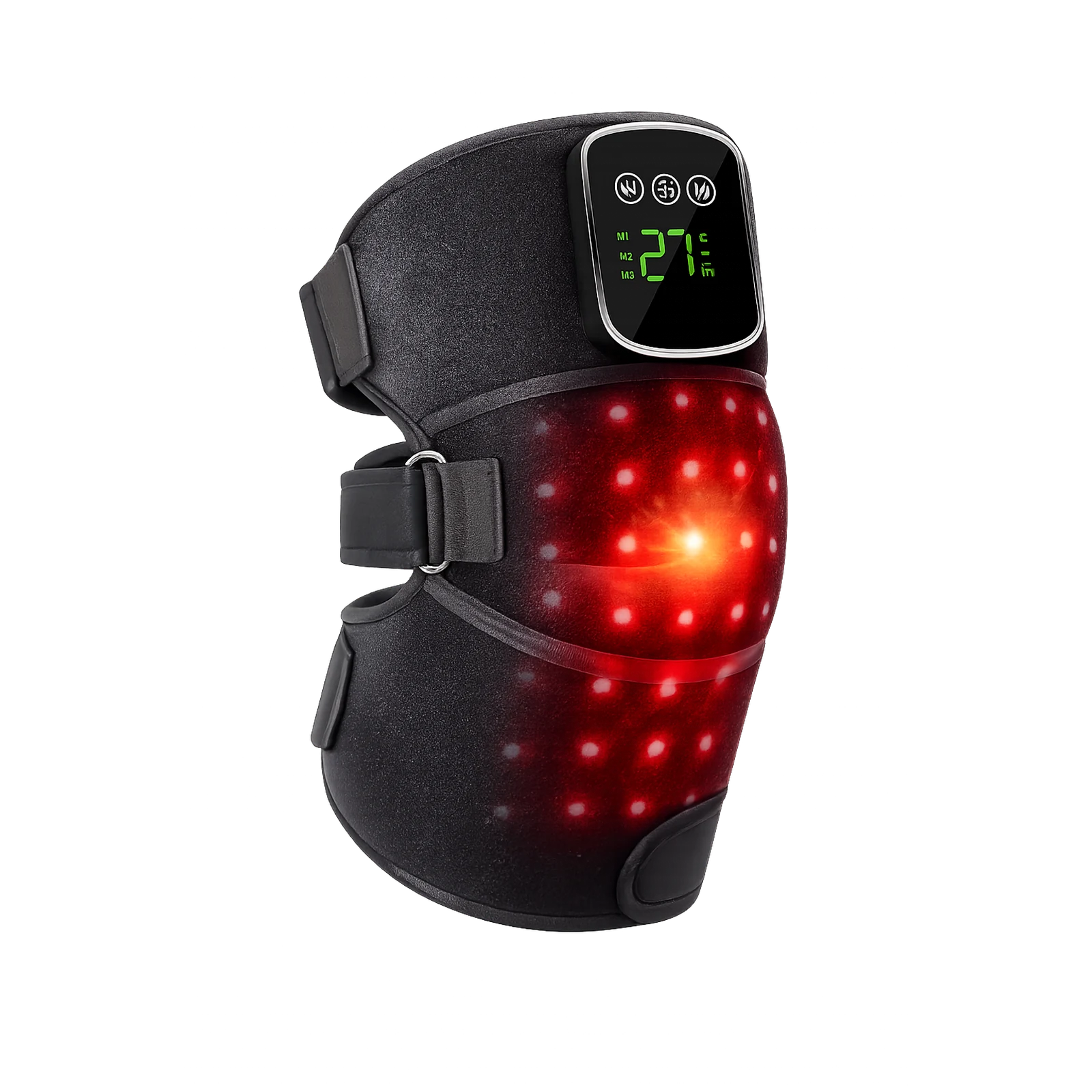
- Knee and shoulder wraps — mixed wavelengths. Buyers of joint wraps expect both, and 660 + 850 on the same board is the standard build. This is what sits inside models like our RKM001 knee wrap and RSM001 shoulder wrap.
- Face masks and skincare-adjacent devices — 630 or 660 only. Visible red is the selling point, customers want to see it working, and you save weight and power by skipping near-infrared.
- Muscle panels and larger recovery boards — 660 + 850, with LED count and coverage mattering far more than exotic wavelengths.
- Waist and back belts — combo again, usually 660 + 850, since these are bought for general soreness rather than one narrow use.
If you take one thing from this section: combo devices sell more easily. Not because the physics is superior, but because “red plus near-infrared” reads as a complete story in an Amazon bullet, while red-only invites the obvious follow-up question. When a buyer can’t decide, we point them at a combo build and they rarely regret it.
The wider decisions around form factor, tooling, and packaging sit outside this article. We walk through those in our full guide to launching a private-label red light therapy device, and you can see the current range on our red light wellness products overview.
OEM Spec Sheet Template
This is the part your factory actually needs. Six lines, and a quote stops being a guess:
- LED count and wavelength split — write it as a split, not a total. “120 LEDs: 60 × 660 + 60 × 850” leaves nothing to interpret.
- Irradiance — in mW/cm², and always with the measuring condition attached.
- Treatment time — session length and auto-off. 10 / 15 / 20 minute presets cover most consumer products.
- Beam angle — 30°, 60°, or 120°. Narrow concentrates intensity on a small area; wide spreads it out. Wraps sit against the body, so wide usually wins.
- Coverage area — the active surface in cm². This is what your customer feels, and it’s easy to forget.
- Power source — rechargeable or plug-in. Our wraps typically run a 5000mAh Type-C battery; panels and back wraps are often mains-powered.
A warning about irradiance, since it’s the number most often inflated. It depends entirely on measuring distance. A figure taken at skin contact and a figure taken at 15cm are not the same claim, and comparing two suppliers on unqualified numbers tells you nothing. Ask for the distance and the meter used. We’d rather hand you a modest, honest reading than a heroic one you can’t reproduce.
Once the sheet is filled in, the rest moves at a predictable pace. Sample in about 7–10 days, production 30–45 days after you sign off the pre-production unit, MOQ 300 per SKU. The clearer your wavelength line, the fewer rounds you burn.
Specifying a device across 630, 660, and 850 feels like the biggest call you’ll make when you’re starting out. Six months after launch, you’ll notice your reviews mostly talk about the strap, the battery, and the box. So pick a sensible combo, write it down precisely, and spend the rest of your attention on the parts your customer actually touches.
Prefer the importer’s-angle version of this topic — how wavelengths tie into compliance language and the spec-sheet questions to ask a factory? We wrote a separate walkthrough of red light therapy device wavelengths for importers.
Ready to take the next step on your red light product?
Tell us your target market and form factor — we’ll send a brief template and a sample quote.