How to Request a Red Light Therapy Device Sample Before Bulk Order
Asking for a red light therapy device sample before you sign off on a bulk run is the least glamorous step in sourcing, and the one I’d never skip. I’ve watched too many first-time buyers jump straight to a 1,000-unit order because a supplier’s photos looked great. Most of the time it works out. But the few times it doesn’t, the cost isn’t just money — it’s a launch timeline that slips by two months and a listing you’re embarrassed to ship.
A sample is not a formality. It’s the one moment in the whole process where you get to touch the real product, test it against your own expectations, and walk away if something feels off. Treat it like the most important ten days of your project. Because it is.
Why a Red Light Therapy Device Sample Comes First
The obvious reason is quality control. The less obvious reason is that every factory describes the same spec slightly differently, and the only way to know what you’re actually getting is to hold it. When you place a private-label red light therapy device sample order, you’re really buying three kinds of proof.
The first is wavelength. A spec sheet might say 660nm and 850nm, but the actual output can drift, especially on cheaper LED chips. With a sample in hand, you (or a testing lab) can confirm the light is doing what the sheet claims. You don’t need to own a spectrometer — but you should know the supplier isn’t guessing.
The second is heat and comfort. A wrap that runs too hot against the skin, or a panel with a fan that sounds like a hairdryer, will get returned by your customers fast. Curved joints are the honest test here — a knee wrap like the LK-RKM001 either sits flush or it gaps, and you feel that in ten seconds. I’ve held wraps where the strap dug in after five minutes, and wraps where you forget you’re wearing one. The sample tells you which one you ordered.
The third is build quality you can’t photograph. Stitching that frays, a USB-C port that wiggles, a button that needs two thumbs. These show up in week one of customer use, not in studio shots.
My actual advice: order from two or three suppliers at once. Side by side, the differences are obvious — one feels premium, one feels like a toy — and that comparison is worth more than any single quote.
What Should Be in the Sample Box
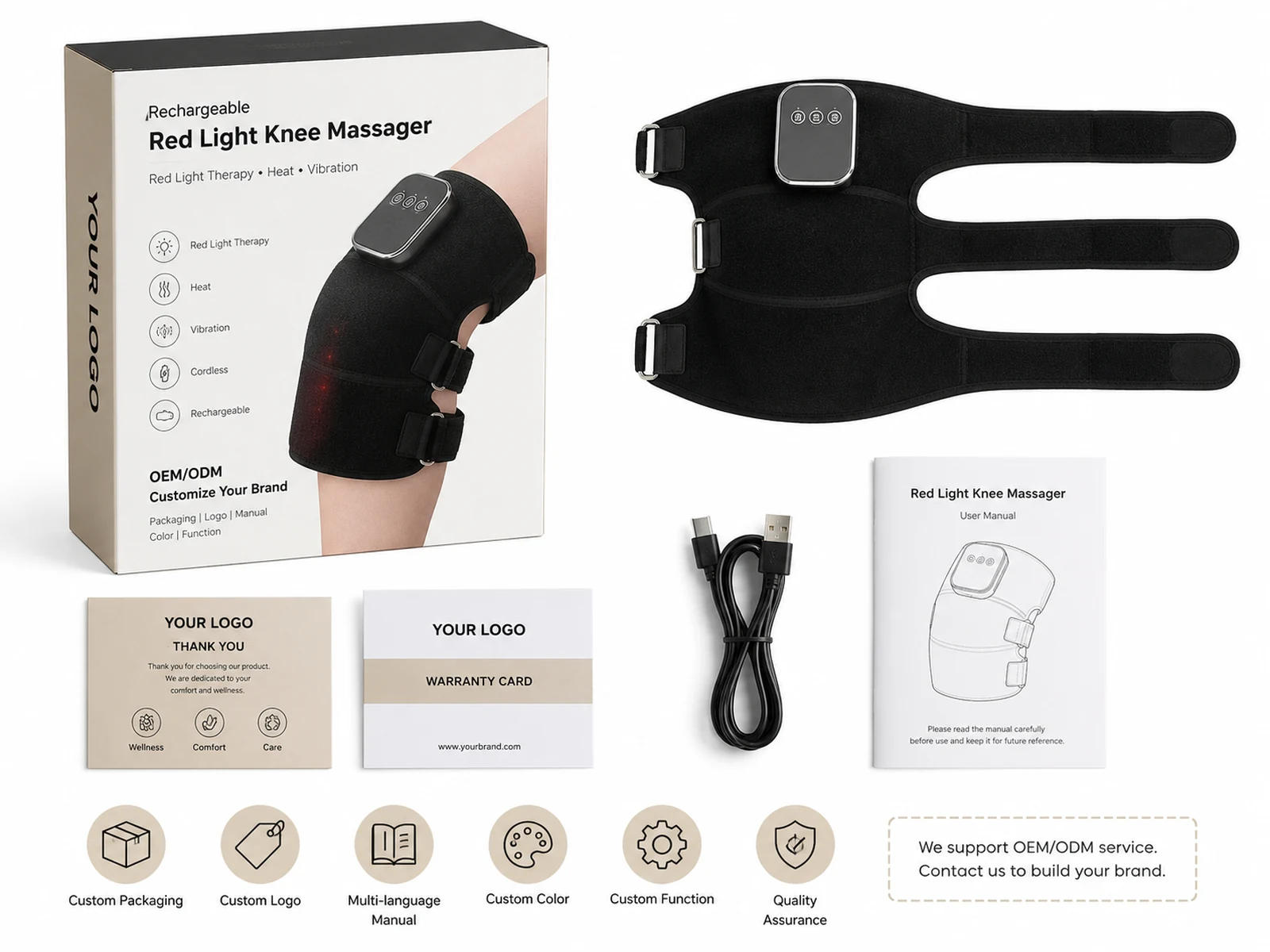
A sample isn’t just “the product.” If a supplier sends you only a bare unit, you’re missing half the picture. A proper sample package should include at least these five things:
- A functioning unit — not a display model. It should turn on, cycle through its modes, and run on its actual power source. On our wraps that means a 5000mAh Type-C battery you can charge and drain.
- The user manual — in whatever language you plan to ship. If the manual is full of broken English now, it’ll be full of broken English at scale. Fix it at the sample stage.
- Certification copies — CE, FCC, ROHS, and the photobiological safety report (IEC 62471) if applicable. You want these on paper before you commit, not promised “after production.”
- The charger and any accessories — cable, adapter, storage bag. What ships with the product is part of the experience, and you should test it.
- A packaging mock-up — even a printed proof of the box and insert. The box is the first thing your customer sees, and a mock-up lets you catch a wrong logo placement or a color shift before it’s printed 2,000 times.
If a supplier resists sending cert copies with the sample, that’s a yellow flag worth pausing on. The good ones hand them over without a fight, because they’ve already done the testing.
One more thing: ask for the exact SKU you intend to order, not a “similar model.” If your listing is built around the LK-RSM001 shoulder wrap, don’t accept a waist version as a stand-in — the strap geometry and LED count aren’t the same. I’ve seen buyers fall for a sample that turned out to be a different board than the production line ran. Match the sample to the PO.
From Sample to PO
Once the box arrives, don’t just eyeball it. Run a short evaluation, ideally with two or three other people who’ll give you honest feedback. A simple checklist keeps you from forgetting the small stuff:
- Does the light output feel consistent across the pad, or are there dim spots?
- How long does the battery actually last versus the claimed time?
- Is the strap adjustable enough to fit a range of body sizes?
- Does the manual read cleanly, or would a customer be confused in the first minute?
- Would you personally pay for this on a competitor’s store page?
Write the answers down. A sample that felt great in your hand at 9am can blur into memory by the time the production quote arrives. Notes protect you. Testing two form factors — a waist wrap like the LK-WSM001 next to a joint wrap — also shows which SKU your audience reorders.
Then comes the part people find awkward: negotiating MOQ after the sample. Here’s the reality. Most factories, including ours, set a typical MOQ around 300 units per SKU. That number exists because tooling, custom packaging, and a production run all carry fixed setup costs. Go below it and the per-unit math stops working for both sides.
But a good sample round earns you leverage. If the sample proved the product is exactly what you want, you can ask about a shared existing mold to lower entry cost, or commit to a second reorder in exchange for a better first-run price. The conversation is easier once the supplier knows you’re serious and informed. I’d rather negotiate with a buyer who tested the unit than one who forwarded a screenshot. Our wellness device sourcing overview lists sampling, certs, packaging, and lead times in one place, so you know what to ask for.
And remember where this sits in the wellness space. Keep your evaluation language about comfort, relaxation, and recovery — not treatment. The sample should feel like something people want to use daily, not a medical instrument.
Ready to take the next step on your red light product?
Tell us your target market and form factor — we’ll send a brief template and a sample quote.